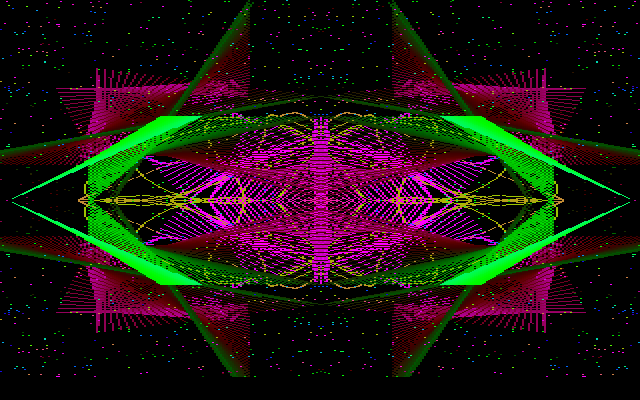
Screensavers in the pre-Windows 3.x, pre-Energy Star world of computing - before monitors could just turn themselves off - were often marketed on being interesting to watch, or even psychedelic. Some even outright described themselves as "trippy" or "on drugs," sometimes as a tacit admission that these were intended to be viewed under the influence, but (I'd imagine) mostly because, in the early 90s, we didn't really have any better ways to describe the sensations produced by these algorithmic graphic demos. Some of them even came with names like "PSYCH" and "RAVE."
Dazzle - later renamed Razzle Dazzle - is an interesting case of one such program that decided not to go down that path. In version 5.0's included documentation (nearly 30 pages worth), Dazzle is self-described as "Performance art for the eyes."
A source of beauty; sometimes subtle, sometimes vibrant, always changing. The image engine has numerous primary image drawing algorithms, most of which have at least two styles of presentation, many of which have multiple internal drawing variations. There is an assortment of fades, including split screens and pans, used by the imaging system for greater diversity of presentation. The entire color range of the detected video system is utilized for maximum variety and visual stimulation.
Expanding upon that last sentence, "detected video system" refers to its support for EGA, VGA, and - rather uncommonly among shareware - IBM's 8514 card/monitor, which could output 1024x768 graphics at an unusual interlaced refresh rate of 43.5 Hz. These cards were not especially common outside of IBM's manufactured machines, as they were designed around IBM Micro-Channel Architecture (MCA) and not the more common ISA slots used by all other PC clones at the time, though some ISA-based cards claimed compatibility with it. But best of all, regardless of video hardware, most of the "magic" of Dazzle is performed with the video hardware itself, so the program boasts compatibility with even an 8088-based PC, in 1992.
But the technical aspects of Dazzle are not the reason I'm writing this post.
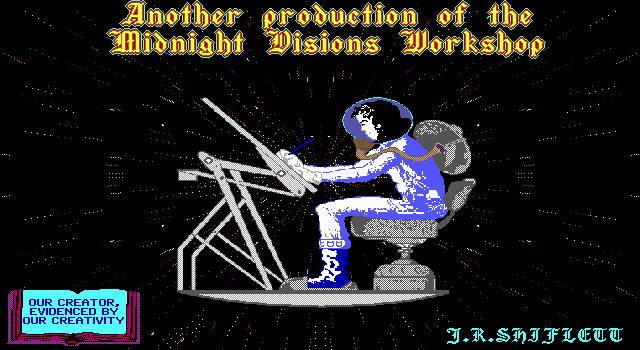
Dazzle was a creation of an author identified as J. R. Shiflett, initially under the moniker of "Midnight Visions Workshop." For the last few versions of Dazzle for MS-DOS (before its name change to Razzle Dazzle and port to Windows), closing the program with the Escape key would show this image of an astronaut at a drawing table. I have a sneaking suspicion that this is not an original picture, and may have been adapted from a more famous drawing, perhaps by a science-fiction artist, but I have no real substance to prove that one way or the other. My focus instead goes towards the book in the bottom-left corner, bearing the phrase, "Our creator, evidenced by our creativity." With relation to the phrase, the astronaut is seemingly intended to visually imply God, or at least a god, in the act of creating the universe. But the phrase itself also brings to mind this quote:
“As my friend Julian puts it, only half winkingly: “God blessed me by making me transsexual for the same reason God made wheat but not bread and fruit but not wine, so that humanity might share in the act of creation.” ― Daniel Mallory Ortberg, "Something That May Shock and Discredit You"
While I absolutely cannot speak for J. R. Shiflett's stance on transness (or queerness for that matter), the included documentation does make a lot of other aspects quite clear, including not only the meaning of that phrase on the quit screen, but also - purportedly - the meaning of life. That's literally the title, and first paragraph, of the chapter:
15. THE MEANING OF LIFE
Some of you have questioned me about the "Our Creator, evidenced by our creativity" message on the program credits artwork screen. This section is perhaps the best way to answer all the questions. I hope you will receive it in the same friendly spirit in which it is offered.
This section of the document takes up three entire pages, 14 paragraphs, and includes six Biblical quotations and numerous other citations. It is unclear to me, without actually trying to read it critically (I feel I have better things to do), whether Shiflett has any major point to this chapter, beyond (probably) to demonstrate that we are a species of creators who create because our creator made us in his image. Which seems like a fairly pedestrian way to interpret it, probably, but I'm not exactly a religious scholar. (Frankly I've been trying not to be, but that's neither here nor there.)
So, I am left with this as a story to tell people, in the form of, "Hey, did I ever tell you about that old DOS shareware program with a long-ass religious screed in the readme file?" Or that this isn't even the only time that's happened, either, but that's... definitely something for a different post. If you're interested in reading all of it for yourself, download DAZZLE50.ZIP from the Internet Archive and open the included DAZZLE.DOC in your text editor of choice.
And if anybody knows whether that astronaut is from a famous painting or book cover... I'd appreciate putting that mystery down after thirty years or so.