1996 AD: the year of the Nintendo 64, the movie Babe on VHS, and The Monkees’ 30th anniversary reunion tour. By this point in video game history, the First Person Shooter has not only been established as THE hip new genre to be in, we've seen 3D rendering technology jump leaps and bounds in the just over two years since Doom happened. We went from flat, 90 degree corridors to grand structures of shapes and sizes that would make a Brutalist architect wonder what they've been doing with their life. We went from everything being Day Glo colors, to the moodiest stuff this side of the Alien movies. Basically, Doom made people really Figure Shit Out about how to make a game that just pulled you in and never let go, and the likes of Duke Nukem followed right in its footsteps and pushed the tech concepts just that little bit further. The FPS was the cream of the crop for showing off what your hardware could do, and it was about to get that much greater, really, really soon.
For PC users.
See, by 1996, the PC was about to experience the biggest technological leap since last week, as Quake was going to deliver ultra fast paced fully 3D environments, monsters that you can view from any friggin angle you want, and real time lights that looked good enough that you could forgive the devs for only including 5 unique color ranges in the palette. All this on an engine that, if you had the latest Intel processor, you were going to be seeing at a blazing 30 frames a second or more. People were already buying PCs en masse, too, because of that other huge technological leap, the World Wide Web, so the PC as a platform wasn’t just the biggest technical badass on the block, it was also getting to be the most omnipresent.
Meanwhile, every other computing platform on Earth struggled to keep up with the install base and the raw brute strength of the mighty IBM Compatible. You had folks trying to get Doom-like engines working on their other machines that used to be impressive, like the Atari ST, the Amiga, the Archimedes, game consoles like the Sega Genesis, and so on. Problem was, these machines generally low balled their CPU speeds to keep costs down, and the often-custom 2D graphics hardware that was so good at flinging sprites around the screen, was just not up to the sorta 3D math that you'd need to render a Doom like engine. If you wanted a game that ran as fast as Doom, while looking as sharp, you'd either go PC, or you'd go home.
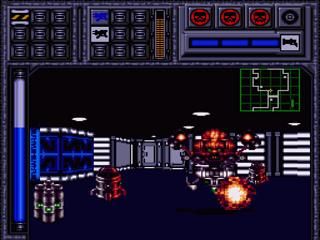
Battle Frenzy - Domark Software, 1994, Sega Genesis / Sega CD. (Screenshot by MobyGames user 666gonzo666)
All that, of course, excludes the one other system that might keep up with the likes of the PC: the Apple Macintosh, the platform that approximately nobody thought about when it came to games, least of all Apple themselves. If you weren't buying a Mac to make magazine layouts or movies with it, Apple really didn't care that you existed, despite the best efforts of the late Rebecca Heineman and other highly devoted game-porters. Apple’s hardware markup was not helping matters; you’d get a lot less computer for your money if you went for a Macintosh than you would with even a low-end Compaq or Packard Bell. A low-end Power Macintosh in 1995 would have retailed for between $1,900 and $2,300; that much would get you a Performa 5200CD, sporting a 75 MHz PowerPC 603e with 8 MB of RAM, and a built-in screen and double-speed CD-ROM drive. That same amount of money would also get you an AST Advantage PC, with a 66 MHz 486DX2, 8 MB of RAM, double-speed CD-ROM drive, a separate monitor bundled with it, internal modem (which wouldn’t come standard on a low-end Apple)… with room to grow, and the software would be a hell of a lot easier to find in stores. What was a few extra megahertz, to the consumer who wanted to see what this whole America On Line thing was all about?
There was little reason for game publishers to care, either; the Macintosh game market share was pitiful compared to that of the PC. Macs were barely selling in the early 90s as it was, meaning demand for games often came from a loud but small contingent of Apple Faithful. Mac users who wanted games, often waited months, or years, to be able to play the kind of stuff their pc brothers had, usually for as long as it took one or two diehards to get a port together and then painstakingly shove it through their publishers until they finally agreed to put it in stores. When Wolfenstein was making waves in 1992, the closest thing the Macintosh had in response was the BattleZone-like game, Spectre, that had come out the previous year. Apple-heads wanted in on that life-like Nazi-shooting action, but they wouldn’t get it yet. Roughly one year into that agonizing wait, Pathways Into Darkness was released as a Macintosh exclusive, a 3D action dungeon-crawler that may not have been as fast as Wolfenstein, but the critics loved exploring it, and hey, it had Nazis in it too (even though they were already dead). Doom, releasing mere months later at the end of '93, shook up the PC ecosystem across the globe, but again, the Apple Faithful would be left out for now.
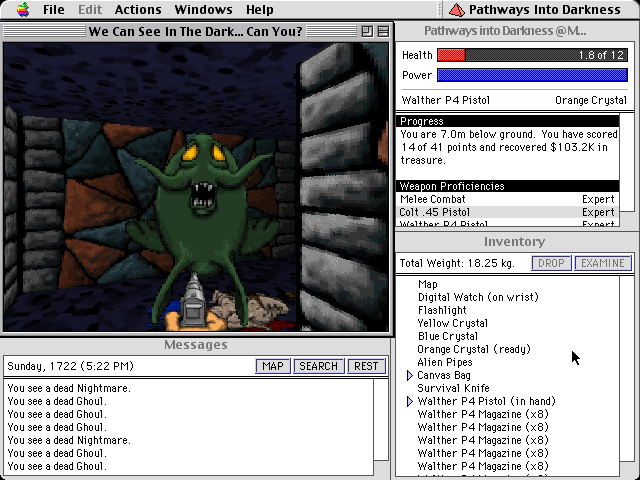
Pathways Into Darkness - Bungie, 1993, Macintosh. (Screenshot by MobyGames user Tashtego)
It isn’t to say that the Macintosh wouldn’t get what the PC had at all, though. The Apple Faithful wouldn't see a Macintosh-native Wolfenstein 3D until the dawn of '95, a bit over a year after the PC got Doom, and even that required publisher Interplay to get involved (by way of their subsidiary, MacPlay). By then, the PC was seeing the likes of Duke Nukem 3D, and the hype machine for Quake was in full swing, so the Faithful were getting a bit antsy. The creators of Pathways Into Darkness, fortunately, had already been cooking their next opus, on a highly atmospheric, Doom-like engine, and would finally unleash it upon their willing thralls in 1995: Marathon. That name is important, by the way.
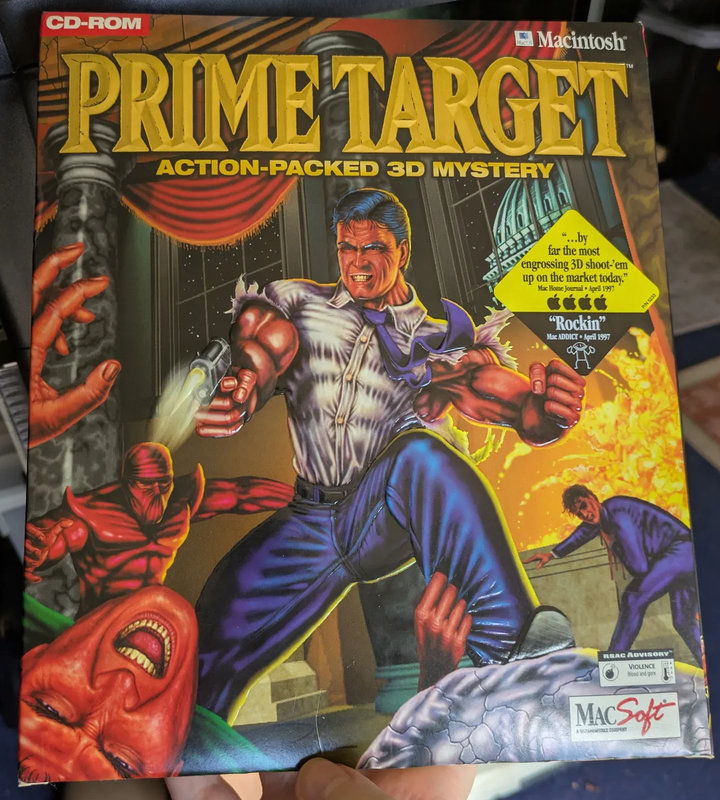
Marathon made huge waves among the Apple Faithful for its epistolary storytelling, tense atmosphere, and surprisingly deep multiplayer mode (complete with Deathmatch-specific maps). But by the time that hit, the “Doom-clone” genre had gone absolutely nuts in PC land. MS-DOS users were eating good, with the likes of Rise of the Triad, Ken’s Labyrinth, Heretic, and Star Wars: Dark Forces; all but one would remain PC-exclusive for the time. The big one, though, was Duke Nukem 3D, a game that might not have been the technological leap that Quake yet promised to become, but definitely made up for it in sheer personality. Mac users... would get it in another year and a half. In the meantime, of course, someone was already brewing up an interim replacement, lifting a page or two from Duke’s real-world-adjacent setting and muscle-bound hero, albeit not the movie references or the attitude. That replacement: Prime Target.
Released by MacSoft, the Mac-specific arm of WizardWorks and later a label of GT Interactive, Prime Target can be best described as Die Hard Goes To Washington. (Except not like that time Die Hard actually went to Washington.) So the story goes: It's 2004. The economy is in the toilet, the national budget is running a severe deficit, and the US Government is Shut Down. (Sounds familiar.) You play Totally Not Steven Seagal, this angry muscle dude who barely fits in his button shirt and tie. You're probably a Secret Service agent, or CIA, or Insert Government Agency Here, I'm not sure they ever tell you, but it doesn't matter, you're a guy with a gun and a chip on his shoulder. In a lovingly filmed FMV sequence, you get a video phone call from Senator Katherine Mayfield, who calls you down to her office because she doesn't feel safe with all these weird armed men in suits in the building. She bites it just before you get there. They want to pin the blame on you, so it’s time to prove your innocence by way of wholesale slaughter while collecting evidence of Shady Corporate Dealings.
Setting the stakes with precisely three actors.
Now, I should mention at some point that I've been planning to write these things, about this game, since roughly 2020; I even almost had the script ready to record for a video by the start of 2021. And then 2021 happened. On January 6th, 2021, right-wing extremists - some of them armed - stormed the United States Capitol, broke into the offices of senators, representatives, and the Speaker of the House, and they trashed the place. Who the hell knows how far they’d have gone if the place wasn’t evacuated. In Prime Target, extremists (their political leanings unclear) storm the Capitol, all of them have guns, they break into the offices of senators and representatives, and murder the one that’s still in the building.
This isn't a coincidence, but it also isn’t a prediction of the future or anything resembling inspiration for the real-world parties involved. Frankly, we've had the writing on the wall for decades, especially since pop culture has been collectively filling us with these ideas that politicians are beholden to corporate interests (not that that’s false at all), and people with guns are here to shut up anybody planning to stop said interests (for money or indoctrination, doesn’t seem to matter). There's also some other foreign or obviously criminal faction at work, so that we can have a nice and unambiguous Other that we can fill with lead without feeling guilty about it.
What Prime Target is doing here is not predicting the future, that's every shoot-’em-up action flick since the Reagan administration. It’s like why The Simpsons and RoboCop are still relevant 30 years later, because the cynicism has been here for decades, and nothing about American politics has really changed since Reagan left office (except in the ways it’s gotten more and more blatantly stupid). The people who make games that are “inspired by 80s action movie classics” are probably too busy missing the deeper messages and meanings behind them, or Hollywood’s bizarre obsession with re-fighting the Vietnam War, and just want to make a game where you have excuses to blow away crooked cops and skinheads in the Smithsonian - and yes, as the author of the similarly-inspired Weasel Presents: Terrorists, I do appreciate the irony here.
But where blowing away crooked cops and skinheads is concerned, boy oh boy does Prime Target deliver. You probably mow down at least five Arnold movies worth of gunmen, badged or otherwise. About the only thing it's missing from the parlance of the 80s are the one-liners and the blatant xenophobia. I mean, unless you count the ninjas, but if movies have taught us anything, it's that anybody can be a ninja, even if you're whiter than me.
Neon ninja carnage.
Prime Target, being basically a budget release, was built on a licensed, pre-existing engine. Not Build, like you might think when I say "budget," since the Mac port of Build Engine was still about a half year away. Marathon. Yeah there's that name again. In 1995, Marathon made such a wave to the Mac community that Bungie (THAT Bungie, HALO Bungie, DESTINY Bungie) got plenty of clients licensing their engine to make their own Mac and sometimes PC shooter games. And they're all unusual beasts in themselves, because you got stuff like Damage Incorporated giving you squadmates that take orders and backsass you if you suck; the playable KMFDM music video that is ZPC, and uh, this game that's supposed to teach kids how to drive electric wheelchairs.
A lot of these licensees inherited the Weirdness from Marathon. Marathon's movement physics are subject to a bizarre kind of moon gravity, where you feel like you're moving in slow motion and fall really slowly, but you also have no air speed control, so you'll keep moving forward at a constant speed if you run off a ledge, but you can still turn, which immediately changes which direction you're falling as if you have a tiny parachute, so you can kinda curve your jumps in a weird way.
Building a game on Marathon encouraged developers to do weird stuff. Gigantic decorative status bars that seem allergic to having visible numbers, extremely narrow FOV angles, bizarre weapons with even more bizarre alternate fire modes, lots of "found document" style storytelling...I guarantee you it’s written by that guy that aced his college creative writing course entirely by clipping chapters out of his sci-fi magnum opus that he's been writing since he was 12. And that's not even to get into their tendency to name their maps stuff like "Zero G Sunbathing," or "PermaShed Potatoes," or prog rock lyrics, or whatever Latin phrase sounded cool at the time. Marathon-engine games also tend to have unusual inventory systems, on top of weapons that need to reload (though never manually; only once the weapon is empty). The inventory window, then, is written out like a cargo manifest, helpfully divided in sections in case you really wanted to see the exact names of every weapon you own, and ammo is counted by entire magazines, not bullets.
What makes Prime Target such a weird example of a Marathon engine game is the ways in which it decidedly ISN'T weird. The devs at MacSoft sped up the player movement, fixed gravity (kind of), turned the health and inventory system into something with actual numbers that you can read... though there's still bar graphs for the health and armor, kind of, like this one where your guy's shirt explodes if his armor's gone.
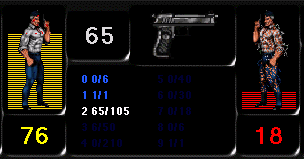
Whoof. Beefcake.
You've got jump and crouch keys now, doors actually move like real doors do (a literal selling point, on the back of the game’s box), there's no terminals you need to read, you don't need to find save points or save tokens or any of that to be able to save, there's no Alternate Fire modes. Somehow the devs took the weirdest FPS engine of the mid 90s and successfully disguised it as a Build game. Now that's not to say that ALL the Weirdness is gone, because Prime Target does still have a fairly unique visual style; you'd think with the FMV intro video that everybody in the game would be made from digitized photos of the programmers holding guns, like Off Brand TekWar. But this game is populated with comic book villains, hand-drawn baddies wearing bright shades of pink and blue, that might not look out of place in a Rob Liefeld series.
And I do also have to say that The Weirdness, sadly, also includes the fact that the mouse look is really broken on newer Mac OSes, and by newer, I mean OS 9.2 from the year 2000, because man, good luck getting this damn thing to work on your Intel or M1 powered Macs. The slightest push of the mouse will either put your head in the clouds or make you liable to shoot yourself in the feet, because I guess the scaling changed somewhere in the change over to USB mice. And this isn't something you can fix with sensitivity sliders, because then you can hardly turn around. So you know what I do instead? I bind up my controls to use the numpad as an ersatz mouse. This creates significant problems for my aim, and is yet one of many reasons why the shotguns and rocket launchers are the only weapons worth dealing with most of the time.
Speaking of shotguns and rockets, you would think that this game, despite the real world setting, would have some 90s FPS arsenal of impractically huge guns, but that's where we get back into Prime Target's mission to be as boringly realistic as possible. You come standard with a nickel plated Beretta that reloads any time the ammo count is a multiple of 15, and the world's limpest combat knife that your guy waves around like he's pretending it's a Quake weapon. These are all the things you'll have to work with for almost one entire level. They give you a shotgun, eventually, but this game doesn't subscribe to the Marathon school of dumping a huge pile of ammo next to each new weapon you get. You get maybe 8 shots with the shotgun, and probably won't find more until the game starts throwing skinheads at you en masse. The shotgun is honestly ok, but in keeping with FPS tradition, you won't be hurting anything with it past about ten feet, and you better be aiming for center mass, or... well, we'll get to that.
The usual game flow of Prime Target involves searching through kinda samey rooms like offices, occasional meeting rooms, once in a while there's a nice set piece room like the Senate floor. There's bad guys, usually only 2 or 3 types in one level and maybe a fourth behind a locked door to catch you off guard, and there's usually two doors that are locked with a certain numbered key card. You see a big ol list of keys on your gigantic HUD, numbered 1 to 32. These are all the keys IN THE GAME. Most of the time you'll unlock one door with one key, and find some Evidence (a letter or something that you can call up and read at any time) and another key that lets you exit to the next level. So, basic trappings, except that this game is hub based.
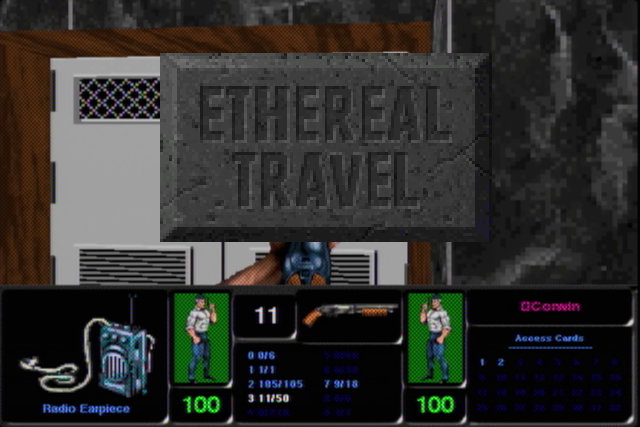
Yup, that's right, we're Hexen now. ... Kind of.
To call it a hub kind of overstates what Prime Target actually does with its level design. What you usually get is a level representing one floor of a building somewhere on Capitol Hill, you exit to the next floor for a second level, then the next exit takes you to a map that's just a long tunnel with occasionally an off shoot into some brick-and-crates sewer full of skinheads with shotguns and/or flamethrowers. Then you get another couple levels in the next building, at some point you DO get to go through the Smithsonian, they just don't call it that, and it's just full of identical portraits of one guy and there's a hedge maze in it for some reason, and while you absolutely can go back to levels you already beat (another literal selling point on the game box), the levels are all just in one long line, and rarely do you have to backtrack anywhere unless you really need health. To a point.
About halfway through, you might see doors labeled Mail Room, or Postal Access, and find that they need Key Card Number 31 and 32. Secret levels, you might think, pondering Doom 2's map numbering system. Nope, they're shortcuts that you unlock halfway in, and the Postal Access tunnel is literally just one long conveyor belt with a few machine gun wielding muscle walls riding it in circles for no reason. Hope you have really good timing, and the luck of the gods on that RNG.
The Marathon Engine has what I would term a Very Generous range of values to its random numbers, and seems to favor extreme values with no particular median. What this basically means is that any given shot you fire, is either going to deal so much Damage it'll convert solid muscle into kibble, or barely enough to wake somebody up. And for the common Beretta and machine gun - this unholy hybrid between a Micro Uzi, a Mac 11, and a... water Pistol, I guess - this doesn't really mean a lot besides how long you'll have to hold down the trigger before the rank and file Suit Men go down. Though sometimes you'll have to reload before the guy's gone down, and that can hurt. But with the Shotgun, a never-reloading death machine with the world's slowest pumping animation and an effective range of "up your nose", the randomness will either make every single blast an instant kill, or they'll somehow survive and immediately unload on you, because these Terrorists are 2D and it doesn't take them time to turn around.
This Shotgun represents MacSoft playing at dethroning God. Every dev and their dogs knew, back in 1996, just how legendary the Doom 2 Super Shotgun was, and almost everybody sought its throne, Prime Target being no exception. Ironically, they bump into the same exact problem the SSG had, in that the shotgun is effectively the only Good Gun in all of Prime Target, and they KNOW this, which is why they practically bury you in shotgun shells while every other gun in the game gets to starve. But a lot like the Super Shotgun, its power is reliant entirely on how good you are at Shotgun Jousting, or charging straight towards somebody and blasting them point-blank before they can get a hit in. If you miss, or get an unlucky damage roll that doesn't erase the man in front of you, it's gonna hurt.
Normally, in other games, situations like this are where I'd start playing mock Time Crisis, popping my head around corners, or abusing that Crouch key, to take a single shot and then duck back to reload, but enemies react INHUMANLY fast to this if they've already heard you coming. The alternative is to follow the tried and tested ambush method, by getting their attention and hiding by the doorway. Sometimes this works, but most of the time, the baddies inside will get smart and just wait there for you. They're all cued up to blast you, they're not going to chase you. It's an unusual change from how these kinds of bad guys work in older FPS games, and a welcome one indeed, compared to, say, Doom demons constantly butting into each other like pixelated Keystone Kops.
It really takes a long time for Prime Target to start showing its hand and letting you see the rest of the guns and bad guys. Sure, it'll tease you once in a while by putting one solitary Ninja in the room where your exit key is at, but with how disposable most of the enemies can be, it's sort of a blink-and-miss-it encounter. You're pretty much going to be leaning on that shotgun as soon as ammo starts showing up for it, which is coincidentally the first time the game starts throwing anything at you that isn't a Man In A Suit or a Man In A Vest. The game starts actually getting threatening when it introduces the flamethrower men, typically just one. These guys hurt like hell, because they're basically firing little mini-missiles at you, and even if you've dodged them, you're still going to get singed a little. They take a pretty significant amount of hurt, too, unless, again, you get up in their grill with the shotgun. And really, at that point, good luck.
If luck is truly on your side, the flamethrower man might drop his flamethrower for you, with one single shot of fuel for it. At this point you might think, cool, new weapon, I'm gonna try it out on something. That's when you realize how limp this flamethrower really is. You know that thing in Japanese RPGs where you have to fight this ultra-powerful Big Bad Guy, and then he joins your party except he’s nowhere near as powerful as he was when you fought him? That’s the Prime Target flamethrower. Here you have the most badass thing the enemies have sent after you to date, that has cost you numerous hit points and maybe made you reload your saved games a few times, but when you get it, it's lost its badassitude.
Marathon’s TOZT-7 flamethrower is possibly the most amazing FPS flamethrower of the entire 1990s. This thing absolutely wrecks entire rooms of dudes and leaves nothing but smoldering ash and the pitiful whimpering of your foes (and any of the poor Bobs that happened to also be in the room). Prime Target elected NOT to use this flamethrower as a basis for its own. Prime Target makes it behave like a Grenade Launcher, with a projectile arc and splash damage. And because this is still the Marathon engine, RNG makes it vary wildly between incineration and ineffectuality. It doesn't help that the fire ball is tiny, moves really slowly, and that the thing has to reload every 4 shots so you can't even properly stun lock anything with it.
More of a flame-lobber. A flame-passer.
You'd be right to assume similar nonsense with the rest of the arsenal. The machine gun is almost the most accurate thing in the game, but can sometimes take more than the full magazine to kill one thing, so it's kind of worthless on crowds, and it's definitely not going to reliably kill the huge guys that carry them before needing to reload, even if it does a good job of stunning them. You can get a rocket launcher almost immediately if you carefully jump up this fountain in the first level (but you only get a few rockets for it at first), which is almost too good, it even seeks nearby enemies, it just doesn't always pick the best targets, and sometimes it doesn't even try and sails right by them. On the bright side, it's usually a guaranteed kill on the one thing it manages to hurt, because the laws of probability weigh heavily against there being anybody standing next to them when it blows.
And in late game, you start running into the game's one and only female enemy, dressed in full form fitting latex and high heels (it was the 90s, back when artists still thought it was okay to use Playboy centerfolds as anatomical references), and they use the game's only truly weird gun, the liquid nitrogen gun. Basically a pocket Super Soaker that shoots little Shotgun spreads of ice shards for some reason, it's also probably your only really good crowd control weapon if not for its one great drawback.
Ice weapons in shooters have a lot to live up to, or else they become mere gimmicks, stuff you'll use once and then forget you have. Hexen has Frost Shards, a big, loud, powerful ice Shotgun that fires awesome runic shapes of icicles that will just turn anything into a meat popsicle, at which point you can shatter them with your wand, shove them off a staircase, or just kinda leave them there and they'll crumble on their own. Duke had the Freeze Thrower, which you can shoot around corners with expert bank shots, and if you stand close, Duke automatically smashes frozen aliens with his foot and you get the nice satisfying loud glass smash noise to go with it.
Duke Nukem has nothing to worry about.
Our little wintery Super Soaker on the other hand, as good as it does for damage, isn't permanent. If somebody does freeze, it's a minor inconvenience to them at best, since if you leave them alone, they eventually thaw out and resume trying to kill you. You can get frozen, too, by the women in leather, and it just turns your screen blue and prevents you from moving or doing anything to prevent your death by a thousand cuts until you eventually thaw out. And when you've frozen an enemy, there's no quick and easy way to shatter them, short of switching to a bullet weapon, since your twiddly little knife won't do it, and shooting them with more nitro just re-freezes them. And worst of all, there’s no shattering noise, they just kinda explode into blue giblets and whine like they usually do when you shoot them with anything else. Honestly, I just go back to the shotgun unless I'm running low on shells.
Finally there's this thing that shoots electricity, I have no idea how it works because they only gave me one shot with it and it didn't really do squat the one time I ever tried using it. It might be the BFG of this game but I'll be damned if I can ever find ammo for it to try it again.

Pictured: an enigma.
So really at this point, we've established that the level designs get really samey, the enemy variety is barely there, there's only maybe two guns worth using on a regular basis, and the devs have pretty much gone out of their way to throw out all the stuff that made Marathon unique and turned it into a really by the numbers budget shooter. It didn't get popular, except maybe for a couple people. There's no mods. Nobody still plays online and I remain unconvinced anybody ever did. Duke It Out In DC kinda stole its entire schtick and did it better, if only just (even if its Smithsonian level is the stuff of maze-like nightmares, it at least has ACTUAL EXHIBITS in it). There’s ostensibly a Mystery to be solved here via those emails, but I’m convinced it’s just window-dressing and doesn’t really affect the game. What's even left that makes Prime Target that interesting? Honestly? I think it's interesting because it isn’t. Remember, we’re looking at the gaming landscape of the Macintosh, a platform well renowned for having some incredibly weird stuff on it. When your most popular exclusive games involve stuff like a 3D platformer about a pill-bug throwing fruit at stuff, an overhead action game where you’re an executive scooting around on an office chair and shooting staples at killer robots, or like, a game where you’re a paper airplane trying to find a way through a house… Prime Target manages to completely fall short of all expectations of Weirdness and manages to be the single most pedestrian game possible, on an engine and platform that outright encourage weirdness.
Like, sure, MacSoft might have managed to fix Marathon’s physics, add swinging doors and blood decals, and somehow got a QuickTime video to play on this little handheld video-disc player you’re carrying around, but the game you end up getting is just, kind of there. But given the thematic origins of it, the way it’s more or less just any given Schwarzenegger or Bruce Willis popcorn flick or maybe an HBO or ShowTime original but without the biting satire, I’d sooner position it as the game Operation Body Count wished it had been.
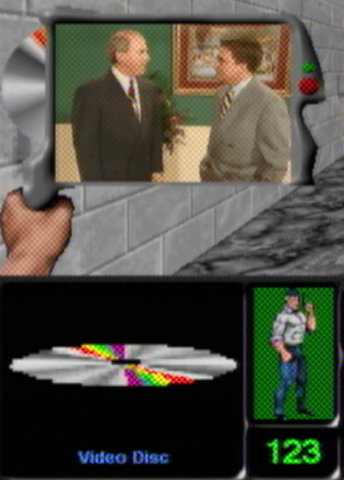
Whatever technical wizardry it took to make this work, it caused the game to crash at least once on my machine and also tanks the framerate.
With all this in mind about the game though, the real question to ask is, in the face of seemingly infinite games that are better than Prime Target, what keeps me interested in Prime Target? What does this game have that supersedes its aggressive mediocrity, if it has thrown out almost everything that could have helped it stand out?
Next to nothing. But that, honestly, has me utterly enthralled.
You see, over the last several years I've been thinking a lot about how we, as video game consumers, latch on to games and spread word to our fellows about them. The majority of them don't really need that kind of word of mouth. Most people who touch video games will probably know that a Super Mario game is good. Call of Duty games spend millions of dollars in marketing to make sure everybody knows when the next one's going to hit. And yet for every One of those, there's thousands that will have gone under the radar, that did not receive the hundred million dollar ad campaign, that somebody will have posted about one time and one other person will have said “wait when did that come out?”
I sit in a place below even that. I find myself skipping the once in a lifetime masterpieces and homing in on the six outta tens, the games that weren't perfect and probably never honestly intended to be. The games that got made because the company just needed to fill a hole in their catalog, where even despite the uninspired storylines and banal level designs, there's still an undeniable fingerprint of real people who did this job. Decisions were being made to get this thing out the door, and I have as much (if not more) fun analyzing and experiencing those as I would with a 70 or 80 dollar triple-A blockbuster event.
I would rather replay the dull, monotonous “Duke 3D with the personality removed” that is Prime Target, than I would Battlefield 6.