Brynhildr
- Base model: Asus motherboard
- Processor: AMD Ryzen 5 3600
- Memory: 32 GB DDR4
- Video: NVidia RTX 2070, through a Sony Bravia television
- Audio: On-board audio, coming out of a VIZIO soundbar
- Storage: 256 GB m.2 SSD, 6 TB hard disk drive, 512 GB SATA SSD, DVD-RW drive
- Networking: On-board Ethernet
- Peripherals: Commonly connected to my personalized XBox Series controller; sometimes also my Valve Index VR headset (when it wants to work).
- Operating system: Kubuntu Linux 26.04
- Role: Primary gaming computer
- About the name: More commonly spelled as Brunnhild or Brunhilda, she is a shieldmaiden who is best known as a main character of the Nibelungenlied, whose quarreling leads to Sigurd's death.


The Gaming Rig, the main machine, the one thing that does everything. She's powerful, quick, and set up for lean-back gaming. Many a year ago, she was Arngrim (the berserker, but specifically inspired by Valkyrie Profile), but individual components (and the case) have changed slowly enough over time that I eventually declared she needed a new name.
After years of being exclusively a Windows machine, I finally bit the bullet and put it permanently on Kubuntu Linux, out of frustration with Microsoft. It has done pretty much everything I've ever wanted. The VR headset not working is entirely the VR headset's fault, I've decided. She still serves just fine for Lean-Back Gaming and Computing, from my comfortable recliner.
Lettfeti
- Base model: Samsung Ativ Book 2 NP270E5J (c.2012)
- Processor: Intel Core i5-4200U, 3 GHz
- Memory: 8 GB
- Video: Intel HD Graphics 4000, outputting to 1366x768 panel, one VGA output, one HDMI.
- Audio: On-board
- Storage: 500 GB SATA solid-state drive (replacing factory 1 TB hard disk), tray-loading DVD-RW drive
- Networking: Built-in Ethernet, built-in Wi-Fi
- Peripherals: 3x USB 2.0 ports... and that's it.
- Operating system: Linux Mint
- Role: It got me (the rest of the way) through college!
- About the name: A named horse of the Aesir, Lettfeti's name apparently translates to "light-footed." The irony is that, even after replacing its hard drive with a lighter SATA solid-state, it's still among the heaviest laptops I own.


I came to own Lettfeti the year after I started college. It was on a discount, and I had figured that anything was better than trying to run Google Docs on only 1 GB of RAM (poor Fafnir...), so this overly large, rather-heavy workhorse became my best friend for a while. I have even briefly tried to use it as a desktop replacement, to varying degrees of success. It's still a solid laptop (in multiple senses). I hope to never need to open it again; this is a model that lacks removable access panels, so modifying it in any way requires popping off the entire bottom half. What a pain.
Draugr
- Base model: Dell Precision Tower 3600, c.2011
- Processor: Intel Xeon E5-1607, 3.0 GHz
- Memory: 16 GB DDR3
- Video: NVidia GeForce GTX 960
- Audio: On-board
- Storage: 1x 500 GB SSD, 1x 1 TB HDD, slimline DVD-RW drive
- Networking: Intel dual gigabit Ethernet card
- Operating system: Linux Mint
- About the name: Perhaps you have encountered draugr as an analogue to the common zombie; draugr are the wandering bodies of the jealous dead, often too stubborn to be laid to final rest.

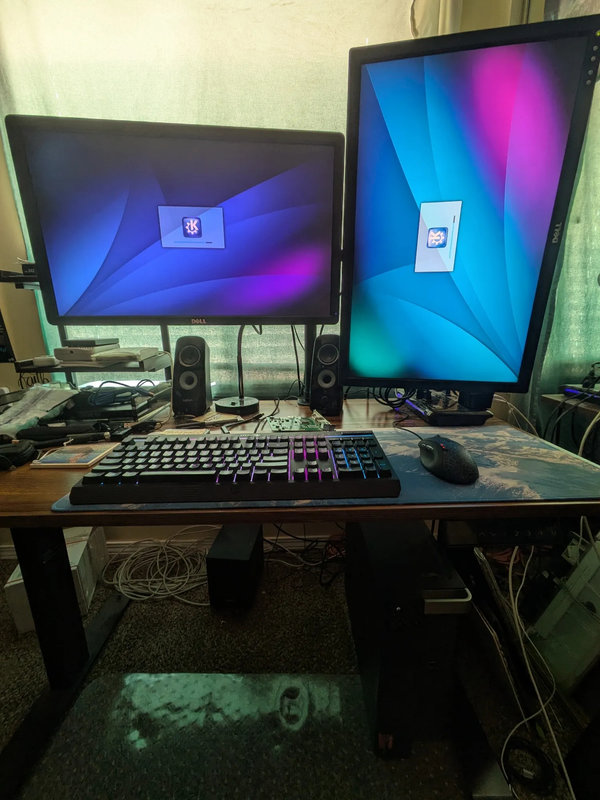
I acquired Draugr at roughly the same time as I did Hvergelmir; outwardly, they are brothers, in the same kind of case, but Draugr is older by a few years. I was rather surprised to find an entire gaming video card installed, alongside a dual-Ethernet card (this was apparently being used as a router?). Rather like Hvergelmir, I had tried a few Linuxes on it before settling on Windows 10, but for a different reason; Draugr is, for some reason, configured as a RAID, which I have never figured out how to disable. It has since been reconfigured by plugging its storage drives into the SATA ports that are not part of that RAID.
Draugr originally came to me with 4 sticks of 2 GB DDR3, but I found some extra RAM in another unused machine (undocumented on this site) bringing it up to a much more comfortable 16 GB, with which it serves as my current Desk Machine, replacing Brokkr.
Hvergelmir
- Base model: Dell Precision Tower 7810, c.2016
- Processor: Intel Xeon E5-2620 v3, 3.0 GHz
- Memory: 32 GB DDR4
- Video: NVidia Quadro P2000
- Audio: On-board
- Storage: 1 TB hard disk drive, slimline DVD-RW drive
- Networking: On-board Ethernet
- Peripherals: Blackmagic Design Decklink Mini Recorder
- Operating system: Windows 10 22H2
- Role: Video capture and encoding
- About the name: The well at the roots of the world tree Yggdrasil.


Hailing from "that place where all the TV is made" according to a previous handler, Hvergelmir was full of surprises from the very day I came to acquire it: three Blackmagic Decklink cards (not cheap on their own!), and a Quadro video card (also not cheap!). I experimented with free operating systems for it (Rocky Linux, Fedora Core, and Kubuntu) before finding that the Linux support for the Blackmagic cards was lacking at best. Now with Windows 10 installed, Hvergelmir fulfills a strong role working in tandem with Grandma's old VCR and a surprisingly capable slimline DVD drive, to serve as a Media Ingester for the home video server (Mimisbrunnr).
I eventually removed a couple of the DeckLink cards; I can't do anything useful with the Decklink Quad, but the extra Decklink Mini has gone into Brynhildr, where a Nintendo Switch is hooked up to it for Reasons.
Terryza Stick PC
- Base model: Terryza Stick PC (Intel Compute Stick clone)
- Processor: Intel Atom x5-z8350, 1.66 GHz
- Memory: 8 GB
- Video: Intel HD Graphics, served over hard-wired HDMI plug. Six-inch HDMI extension cable included.
- Audio: Built-in HDMI output
- Storage: 128 GB eMMC storage, microSD slot
- Networking: Built-in Wi-Fi
- Peripherals: One USB 3.0 port, one USB 2.0 port, and that's it
- Operating system: At last recollection, Linux of some kind

A clone of Intel's briefly-lived Compute Stick line of ultra-small computers, the Terryza is more capable than it seems, plugging directly into an HDMI port and receiving power over a micro-USB port. I had thought these would have come with software to allow a mobile phone to control it via Bluetooth, but alas, such is not the case. I have yet to find an HDMI port it'll actually fit into without needing the 6-inch extension cable. For any serious use, it needs a USB hub, or else there's not going to be enough ports to do anything useful. But the Terryza really isn't meant for serious use. Which is just as well. I bought it entirely for laughs as it is.
Skirnir (The Wonder Craptop)
- Base model: Lenovo IdeaPad 120S-14IAP (c.2017)
- Processor: Intel Celeron N3350
- Memory: 2 GB
- Video: Intel HD Graphics 500, outputting to 1366x768 panel, one HDMI output
- Audio: Built-in
- Storage: 32 GB eMMC storage, microSD slot
- Networking: Built-in Wi-Fi
- Operating system: Linux Mint at the moment
- About the name: Skirnir is a messenger of the god Freyr. Fitting, then, that Skirnir is thin and light-weight, even moreso than Sleipnir.


Initially specced as a "Winbook" - a low-cost, low-spec laptop intended to interact with the world exclusively through a web browser and nothing else, like a Chromebook but running Windows 10 - I found Skirnir was not meeting its potential that way. However, with only 32 GB of internal storage, OS options were quite limited. I experimented with a few Linuxes (like Bodhi, because Enlightenment is a fun WM) until settling on Linux Mint, which surprisingly doesn't run awfully with only 2 GB of RAM. Its CPU vastly outstrips the rest of the specs, somehow, leading me to add a title to its Norse name.
Sleipnir
- Base model: MSI Modern (c.2019)
- Processor: Intel Core i5-10210U, 2.6 GHz
- Memory: 16 GB
- Video: Intel UHD Graphics, outputting to 1920x1080 panel, one HDMI output
- Audio: On-board
- Storage: 500 GB solid state drive, microSD slot
- Networking: Built-in Wi-Fi
- Peripherals: 3 USB 3.0 ports, one USB-C port (charger-capable)
- Operating system: Windows 11
- Role: Primary laptop
- About the name: Odin's legendary horse, said to have eight legs (or more) that account for its absurd swiftness.


My most powerful laptop (for now), Sleipnir has filled a lot of needs on the go. While lacking discrete video, the integrated graphics are no slouch. I don't quite know how its "performance mode" settings work - in practice, they seem like they reduce framerates in games? - and it has two Backslash keys for some reason. But it's a reliable thing and lighter weight than its immediate forebear.